
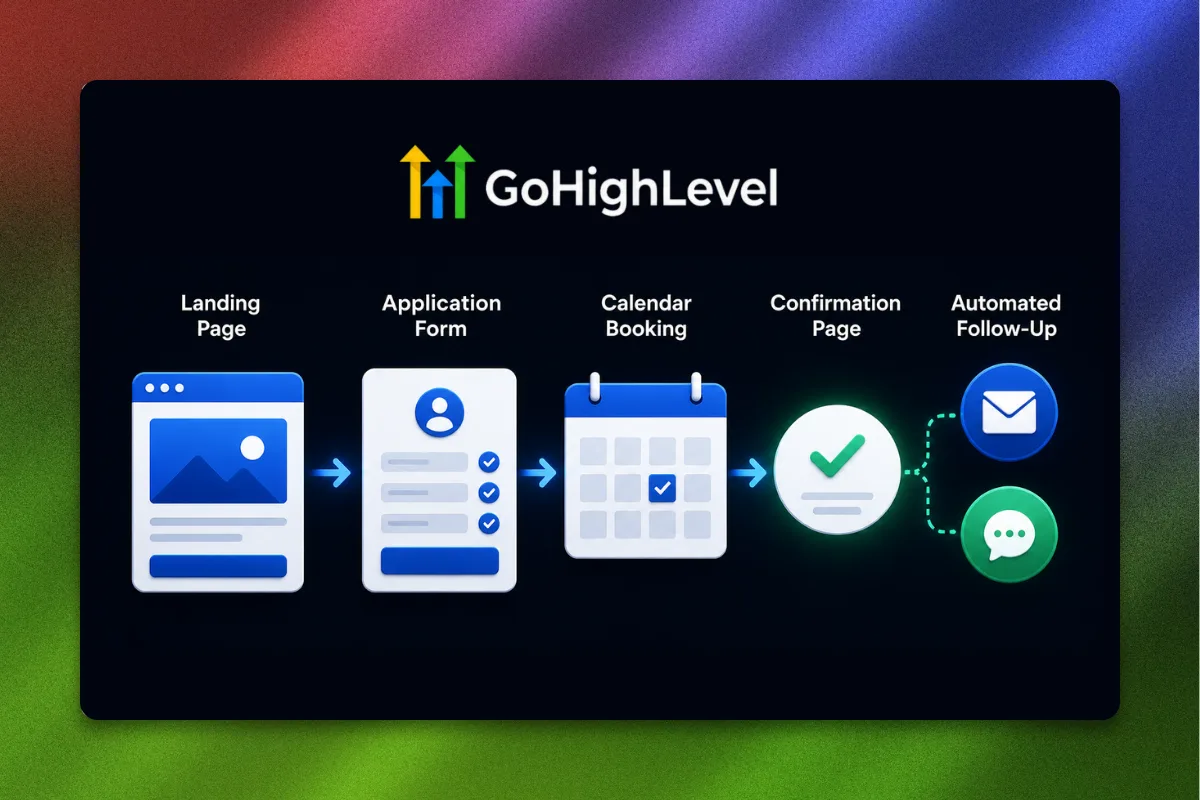
Most high-ticket funnels look similar.
A landing page.
An application form.
A calendar.
A sales call.
And yet some businesses consistently book qualified appointments while others struggle to generate conversations with serious buyers.
The difference isn't usually traffic.
It's not even the offer.
It's the funnel structure.
In 2026, buyers are more informed, more skeptical, and have more options than ever before. If your funnel doesn't build trust, qualify leads, and remove friction, you're losing potential clients before the sales conversation even starts.
Here's the exact high-ticket funnel structure we recommend for agencies, coaches, consultants, and service businesses in 2026.
Why High-Ticket Funnels Still Work
Every year someone claims sales calls are dead.
Every year high-ticket businesses continue closing deals worth thousands or even tens of thousands of dollars through discovery calls.
The reason is simple.
High-ticket offers usually involve:
Higher investment
More risk
Longer decision cycles
Customized solutions
People don't spend $5,000, $10,000, or $25,000 without a conversation.
Your funnel's job isn't to make the sale.
Your funnel's job is to get the right person onto the right call.
Step 1: A Landing Page Focused on One Outcome
The biggest mistake we see is trying to sell everything.
Your landing page should focus on:
One audience
One problem
One outcome
Bad example:
"We help businesses grow."
Good example:
"We help roofing companies generate 30+ qualified leads every month without relying on referrals."
Specificity attracts qualified prospects.
Vague messaging attracts everyone and converts no one.
Your Landing Page Should Include:
Strong headline
Clear offer
Video Sales Letter (VSL)
Social proof
Case studies
Frequently asked questions
Call-to-action
Every section should move visitors toward one goal:
Submitting the application.
Step 2: A Short Qualification Form
Not everyone should get access to your calendar.
The purpose of the application isn't to collect information.
The purpose is to filter.
Ask questions that reveal:
Current situation
Goals
Budget
Timeline
Fit
A good application helps both sides.
You avoid wasting time on unqualified leads.
They avoid booking calls for offers that aren't right for them.
Keep It Simple
You don't need 25 questions.
Most businesses can qualify effectively using:
Name
Email
Phone
Current challenge
Revenue range
Desired outcome
The best forms feel conversational rather than interrogational.
Step 3: Immediate Calendar Booking
This is where many funnels lose leads.
A visitor completes the application.
Then they're told someone will reach out later.
Now you've introduced delay.
Delay kills momentum.
Instead:
Application → Calendar → Confirmation
The booking should happen immediately after qualification.
The fewer decisions required, the higher your conversion rate.
Step 4: Confirmation Page That Builds Excitement
Most confirmation pages waste a huge opportunity.
They simply say:
"You're booked."
That's it.
A better confirmation page should:
Reinforce their decision
Explain what happens next
Increase show rates
Build trust
Consider adding:
Welcome video
Client success stories
Preparation instructions
Expectations for the call
The goal is to reduce buyer uncertainty.
Step 5: Automated Confirmation Messages
The second someone books, they should receive:
Email Confirmation
Include:
Date
Time
Meeting link
Expectations
SMS Confirmation
Keep it short.
People ignore emails.
They rarely ignore text messages.
Using both channels significantly improves attendance rates.
Step 6: Reminder Sequence
No-shows destroy funnel performance.
Even interested prospects forget appointments.
A simple reminder sequence can dramatically improve show rates.
Recommended schedule:
24 Hours Before
Reminder plus value.
2 Hours Before
Quick confirmation.
10 Minutes Before
Simple text reminder.
The 10-minute reminder often has the biggest impact.
People get distracted.
A quick text brings them back.
Step 7: Pre-Call Nurture
The time between booking and showing up matters.
Instead of doing nothing, continue building trust.
Send:
Testimonials
Case studies
Success stories
Educational content
By the time they join the call, they should already believe you can help.
Step 8: No-Show Recovery
Most businesses completely ignore missed appointments.
That's a mistake.
Someone who books a call already demonstrated intent.
A missed appointment isn't necessarily a lost opportunity.
Create an automated workflow that:
Detects no-shows
Sends an SMS within 30 minutes
Offers a rebooking link
Follows up the next day
You'll recover more appointments than you think.
Step 9: Post-Call Follow-Up
Not everyone buys on the first call.
That doesn't mean they're not interested.
Build a follow-up sequence that includes:
Educational emails
Case studies
Objection handling
Client results
Many sales happen weeks after the original conversation.
The Funnel Structure We Recommend
Here's the full flow:
Simple.
Effective.
Proven.
The Biggest Funnel Mistakes We See
Weak Messaging
Visitors don't understand the offer.
Too Many Form Fields
Application fatigue reduces conversions.
No SMS Follow-Up
Email alone isn't enough.
Poor Confirmation Experience
Excitement disappears after booking.
No No-Show Recovery
Leads fall through the cracks.
No Follow-Up
Potential clients disappear after the call.
Most funnels don't fail because of design.
They fail because of missing systems.
FAQs
What is a high-ticket funnel?
A high-ticket funnel is a sales process designed to generate qualified appointments for offers typically priced above $3,000.
How many pages should a high-ticket funnel have?
At minimum: a landing page, application page, booking page, and confirmation page.
Do I need a Video Sales Letter?
No, but VSLs often increase trust and improve application rates.
What's a good show rate?
Most businesses should aim for 70%–85%.
Can GoHighLevel build a complete high-ticket funnel?
Yes. GoHighLevel includes pages, forms, calendars, workflows, SMS, email, CRM, and follow-up automation.
The perfect high-ticket funnel isn't complicated.
It's structured.
Every step has a purpose.
Every page prepares the prospect for the next step.
The businesses generating the most qualified appointments in 2026 aren't using secret hacks.
They're simply building funnels that guide prospects through a clear, intentional journey.
Do that consistently and your sales team will spend less time chasing leads and more time closing deals.