
Marketing produces a lot of numbers.
Website visits.
Social media followers.
Email opens.
Clicks.
Leads.
Appointments.
Sales.
The problem is that more data doesn't necessarily create better decisions.
A useful marketing dashboard should tell you what's working, what's not, and what needs attention.
Start with Business Goals
Don't start by choosing metrics.
Start with the outcome.
Maybe your goal is:
More qualified leads
More appointments
Lower acquisition costs
More sales
Higher customer lifetime value
Then work backward.
Track Traffic
Traffic helps you understand whether your marketing is attracting attention.
Track:
Website visitors
Traffic sources
Organic traffic
Paid traffic
Referral traffic
But remember:
Traffic isn't the final goal.
A website receiving 100,000 visitors but generating no customers isn't necessarily successful.
Track Lead Conversion
Your lead conversion rate tells you how effectively traffic becomes leads.
For example:
1,000 visitors
↓
50 leads
↓
5% conversion rate
This gives you a baseline for optimization.
Track Appointments
If your business sells through calls, track:
Bookings
Show rates
Cancellations
No-shows
A large number of leads doesn't help if nobody books or attends the appointment.
Track Sales
Ultimately, marketing needs to contribute to revenue.
Track:
Customers
Close rate
Revenue
Revenue per lead
Customer acquisition cost
These metrics connect marketing activity to business outcomes.
Track the Funnel
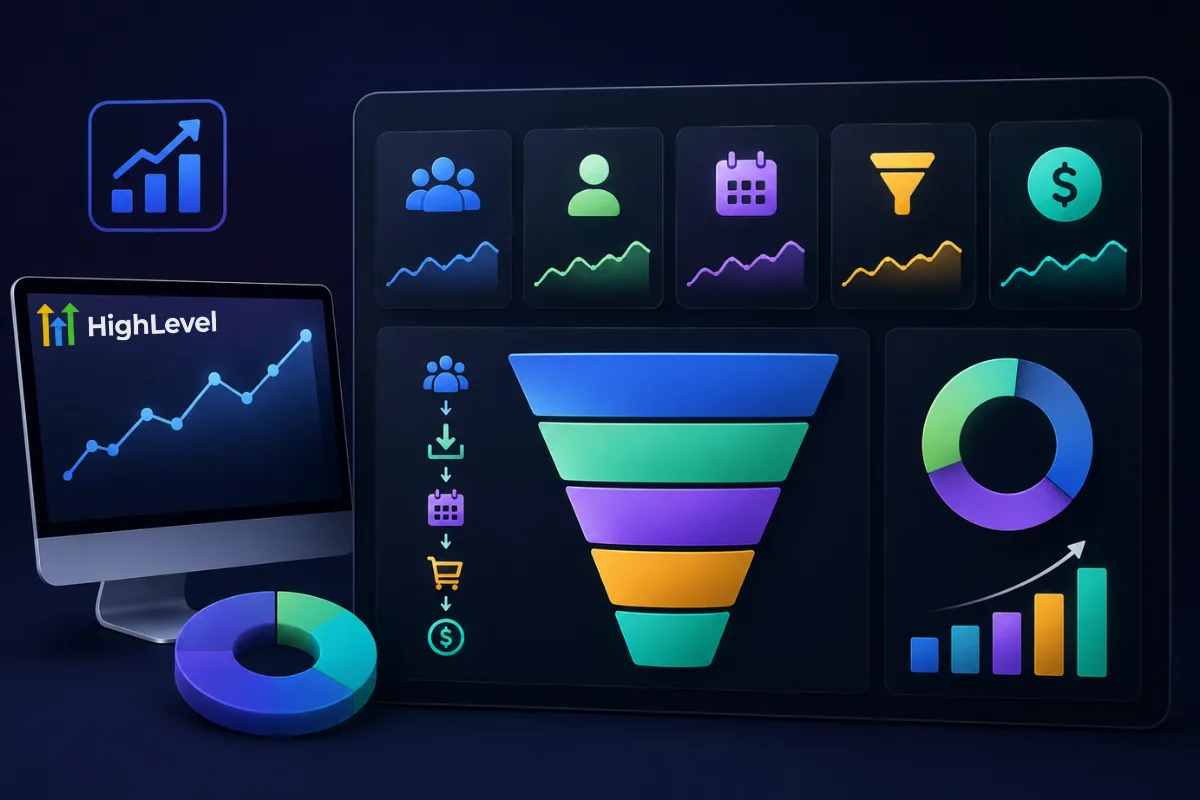
A simple dashboard might show:
If one stage suddenly drops, you've identified a potential bottleneck.
Avoid Vanity Metrics
Some metrics are useful for context but shouldn't become the primary goal.
Examples include:
Follower count
Impressions
Likes
Page views
These can indicate visibility.
But revenue and conversion metrics tell you whether the business is actually moving forward.
Use Data to Make Decisions
A dashboard should lead to action.
For example:
That's much more useful than simply saying, "Traffic went up."
Review Your Dashboard Regularly
A dashboard is most useful when reviewed consistently.
Weekly reviews can identify immediate issues.
Monthly reviews can reveal larger trends.
Use the information to decide:
What should we stop?
What should we improve?
What should we invest more in?
What should we test next?
Marketing dashboards aren't supposed to impress people with numbers.
They're supposed to help you make better decisions.
Focus on metrics that connect marketing activity to leads, customers, and revenue.
The goal isn't more data.
It's better decisions.
Frequently Asked Questions
What should a marketing dashboard include?
At minimum, consider traffic, leads, conversion rates, appointments, sales, customer acquisition cost, and revenue.
Are social media metrics important?
Yes, but they should usually be viewed alongside business metrics rather than in isolation.
How often should a marketing dashboard be reviewed?
Weekly monitoring can help identify problems quickly, while monthly analysis is useful for understanding broader trends.
Turn Marketing Data into Better Decisions
At Havstock, we help businesses build practical marketing systems that connect campaigns, CRM data, automation, and reporting.
The right dashboard doesn't just tell you what happened.
It helps you decide what to do next.